
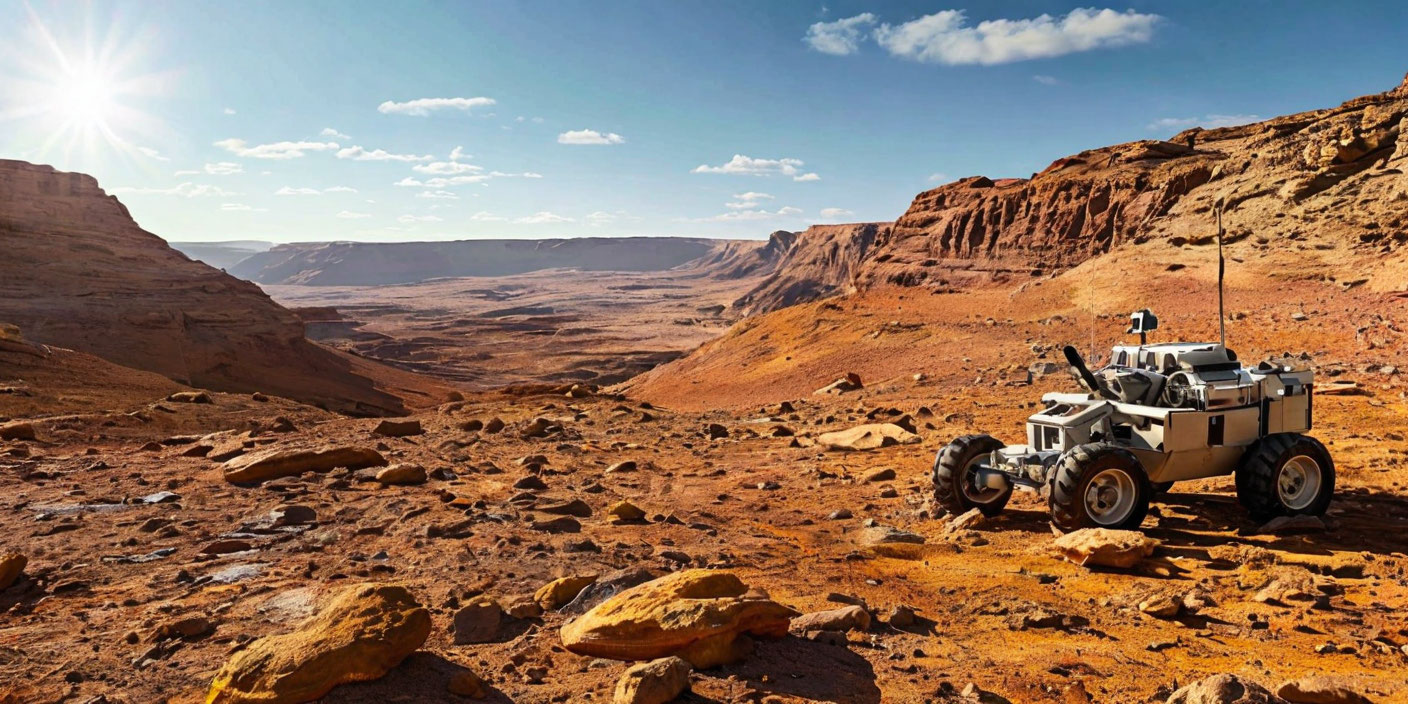
Ровер Perseverance исследует Марс
The Perseverance rover, an American vehicle, has recorded powerful rock deposits on the outer rim of Jezero Crater.
These deposits, according to planetary scientists, were formed as a result of a series of collisions with large celestial bodies. The geological site, named Brum Ridge, is 75 meters thick and, according to preliminary estimates, is older than 3.
9 billion years. This makes it one of the oldest objects on the Red Planet.
The scientific conclusions published in the Journal of Geophysical Research: Planets shed light on the era of intense meteorite bombardment in the early history of Mars. After climbing to the western edge of the crater at the end of 2024, the rover began exploring areas beyond Jezero.
Unlike Earth, where tectonic processes have reworked most of the ancient crust, Mars lacks such mechanisms, so the local rocks have retained their original structure, allowing us to look into periods that have not been preserved on our planet. In the Brum Ridge area, scientists have identified 6 types of rocks, among which breccias predominate — formations of angular fragments, interspersed with fine-grained layers.
Characteristic cavities from gas release and dark glassy spheres found in these layers indicate melting of the substance under the influence of high temperatures during impacts. The size of the largest balls is comparable to those found in the deposits from the Chicxulub asteroid impact on Earth.
The authors of the work explain that the alternation of layers reflects collisions of different intensities: fragments from distant and close impacts settled in this area, and some layers resemble traces of mudflows, indicating possible interaction of molten material with water or ice. The Perseverance team has already selected core samples called «Bell Island» and «Main River».
Their laboratory dating on Earth in the future will help clarify the chronology of bombardments and better understand similar processes on young Earth.